Balancing Fear with Wisdom
Balancing Fear with Wisdom
This week has been challenging on many fronts. Between local icy weather, power outages, and national news, there is no shortage of events to fixate on and worry about. What is happening? What does it mean? Am I safe? These are all valid questions, yet the one that tends to create the most stagnation is the search for why. Many “whys” are simply unanswerable.
So how do we work with that?
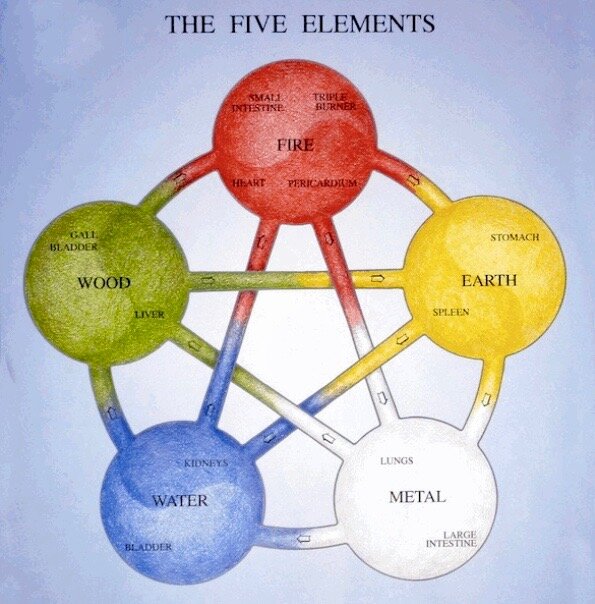
Five Element Theory offers a useful framework for resolving the uncertainty and internal tension created by unanswerable questions. Prolonged uncertainty erodes trust. In response, the mind often shifts into worry—an attempt to predict and control an uncertain future. This is a kind of manufactured trust. It ultimately fails because, at a deeper level, we know there are too many variables to truly control external events. From this gap, stress is born.
I often describe stress as the distance between what is happening and what I wish were happening. The greater the distance between these two, the more intensely stress is experienced. From a Chinese medicine perspective, the Heart seeks peace, and peace is established through order. When the Heart attempts to impose order through excessive control, it overreaches—attempting to dominate the Spleen’s function of trust rather than support it. This forced trust cannot be sustained. As it collapses, fear arises in the Kidneys and anxiety agitates the Heart. A self-reinforcing loop forms: fear fuels control, control increases anxiety, and anxiety further destabilizes trust.
Another way to approach this is to acknowledge that we have very little control over external events. What we do have control over is how we regulate our internal response. While external conditions may remain uncertain, we can cultivate wisdom to balance fear and intentionally nourish trust through preparation and appropriate action.
A practical example is the recent winter storm warnings in Texas. Days in advance, we were told to expect severe cold, power outages, and impassable roads. Faced with these possibilities, the mind could easily spiral into fear (Kidney), anxiety (Heart), and overthinking (Spleen). Alternatively, we could prepare. Looking to past experiences, gathering supplies, and creating a simple plan establishes order. In Five Element terms, wisdom balances fear, and order stabilizes chaos. As a result, the Spleen’s trust is strengthened, giving rise to confidence and quiet courage. Even a basic checklist can significantly shift our internal experience. “What ifs” without a plan create stagnation; small, grounded actions allow energy to move.
The same principle applies to the national and global news. While the suffering we witness is real and deserving of compassion, humans were never designed to absorb the weight of the entire world through a constant, 24-hour media cycle. We are inherently tribal and local by nature. Our nervous systems and spirits are not built to continuously process distant crises over which we have no direct influence.
This does not mean we should be indifferent. It does mean that holding unresolved pain for things entirely outside our control creates stagnation that harms our own health without benefiting anyone else. If you feel deeply affected by events beyond your immediate community, find a way to move that energy constructively—through service, advocacy, or contribution, however small. Movement restores balance.
If you do not have the capacity to take action, then the wiser choice is to consciously release what you cannot carry. Either do something, or let it go. Rumination framed as “hurting for them” helps neither you nor those who are suffering. In Chinese medicine terms, it is simply pain without transformation.
Wisdom does not eliminate fear. It gives fear its proper place.


